Lamb or chicken?
by Silas Martin Bollwe on Tue Aug 11 2026
We Christians follow the Lord Jesus because He laid the foundation for our salvation from the eternal torment of hell on the cross at Calvary.
Christ, born of a virgin, offered His holy blood to atone for fallen humanity—but only for those who recognize Him as Savior, Lord, and God and have surrendered their hearts to Him.
“For by grace you have been saved through faith, and this is not of yourselves; it is the gift of God, not of works, so that no one may boast” (Ephesians 2:8–9).
The basis for blood as a means of redemption from sin has its origin in the Mosaic Law. Once a year, a priest had to offer a blood sacrifice of animals on the altar of the temple for the sins of the people.
“And almost everything is purified with blood according to the law, and without the shedding of blood there is no forgiveness” (Hebrews 9:22).
But this blood sacrifice was only effective to a certain extent, so it had to be offered again and again. This was a foreshadowing of the “once-for-all” sacrifice that Jesus offered on the cross (Hebrews 7:27). Once Jesus’ sacrifice was made, there was no longer any need for the blood of animals. The blood of Christ is the foundation of the “New Covenant.”
The night before Jesus went to the cross, He gave His disciples the cup of wine and said, “This cup is the new covenant in My blood, which is poured out for you!” (Luke 22:20).
The New Covenant replaced the Old Covenant! One cannot live under both covenants, yet millions of Christians are trying to do so because they have not seen this truth. Their lives are not lives of joy and freedom because they still fear God’s punishment as prescribed by “the Law of Moses.”
When Jesus shed His blood on the cross, He fulfilled the requirements of the Old Covenant and replaced the constant sacrifice of animals. The blood of animals was not enough to take away man’s sins because sin against a holy and eternal God requires a holy and eternal sacrifice.
“Rather, through these sacrifices, there is a reminder of sins every year. For it is impossible for the blood of animals to take away sins” (Hebrews 10:3–4).
The blood of animals served as a “reminder” of sin, whereas the precious blood of Christ—the “innocent and spotless Lamb”—fully paid our debt to God for our sins; therefore, no further sacrifice for sin is needed (1 Peter 1:19).
Hence Jesus’ well-known title, “the Lamb of God!” This designation is very important and appears time and again in the New Testament! We are not talking about an animal here; we are talking about none other than the person of Jesus Christ Himself—that is very important to understand!
Before Jesus was crucified, the moral law required that lambs be sacrificed to atone for the guilt of sin. After the Fall, God personally sacrificed an animal to clothe Adam and Eve with its skin. Abraham also experienced a lamb being sacrificed in place of his son. This was done symbolically to point to a greater redemption—namely, the final redemption through Christ.
No animal can take away guilt; it could only symbolically represent faith in the promised Messiah! Because of this faith, people entered paradise before Jesus died. Noah, Abraham, Isaac, and Jacob; Moses, Daniel, Isaiah, Ezekiel, David; and all the people who believed in God for their salvation through the Messiah. For more information, read chapter 11 of Hebrews.
Only the Messiah can take away sins, and that is established forever!
Jesus said, “It is finished,” when He died, which means exactly that: the entire work of salvation from sin was accomplished once and for all, “and an eternal redemption has come” (Hebrews 9:12).
“For if the blood of goats and bulls, and the sprinkling of the ashes of a heifer, sanctifies those who are ceremonially unclean so that they may be cleansed outwardly, how much more will the blood of Christ—who through the eternal Spirit offered himself without blemish to God—purify our consciences from dead works to serve the living God? And therefore, He is also the mediator of the new covenant, so that through His death—which was carried out for the redemption of transgressions under the first covenant—those who were called may receive the promised eternal inheritance” (Hebrews 9:13–15).
This means that we are now not only free from offerings to obtain salvation, but we are also free from religious works to please God.
Through His blood, we are freed from the burden of sin and renewed from within by the Holy Spirit to serve and worship the living God properly (1 Corinthians 5:17).
Now I address all those who believe they still have to make sacrifices.
What could you possibly give to God that is more precious than the holy blood of the sinless Son of God, Jesus Christ?
Light a candle in Rome?
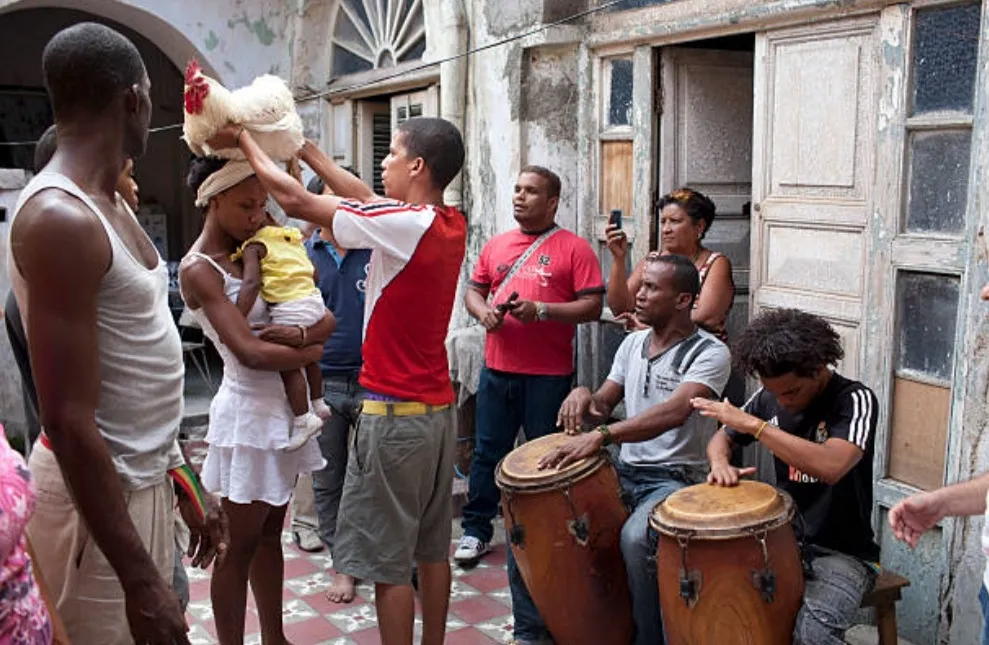
Sacrifice a chicken?
Give money?
Go on a pilgrimage?
Observe Lent?
What do we sinners want to offer to the holy God? What good would it do if we sin again tomorrow? Jesus Christ gave the most precious thing in the universe to secure our salvation from the Last Judgment and Hell—do you see how pointless it is to add to that?
In fact, it is an insult to God to do such a thing, because we have nothing to add to the work of salvation! Such an attempt diminishes the value of God’s blood sacrifice! Let’s be clear: Jesus Christ accomplished a complete and comprehensive redemption from condemnation on the cross at Calvary and sealed it with the words “It is finished.” No one can add anything to that.
Any attempt to bring something to God cannot succeed. Once again: “What does sinful man want to bring to the Holy God?” A chicken that God Himself created? Satan works with such things—he accepts sacrifices—but God accepts only the sacrifice of His beloved Son, Jesus Christ.
Remember Cain and Abel: Abel’s “lamb” was accepted, but Cain’s fruits were rejected. This is an important metaphor for believing in Christ versus trying to be righteous through religious acts! Abel’s lamb was sacrificed in reference to Jesus, “the Lamb of God,” but the fruits represent Cain’s “good works,” which have been shown to be not good at all.
The great prophet Isaiah was right when he spoke these crucial words: “We have all become like filth, and all our righteousness is like a soiled garment. We all wither like dry leaves, and our sins sweep us away like the wind” (Isaiah 64:5).
He does not say that our unrighteousness is like a dirty garment before God, but rather our good deeds! Yet we are supposed to be pure and holy—how does that work?
By allowing ourselves to be washed with “the blood of the Lamb.” This is not a literal process, but a spiritual one that takes place through accepting Jesus Christ as Lord and God. Then the blood shed at Calvary brings about our salvation in the unseen world, and the Holy Spirit comes into our lives to guide us into all truth and positively transform our hearts.
We can (and must) accept His salvation by faith, and we must be grateful children of God in our hearts—those who have been made new creatures by the Holy Spirit.
Let us stop trying to do something for God—and certainly stop trying to influence Him to do something for us—because that leads down the path of witchcraft.
Everything God does for us is based on the cross of Jesus, where God demonstrated His love for us and where we must go in faith.
What God wants from us is our heart—our love for our Redeemer. God wants us to become His children, and in doing so we attain the highest goal a human being can achieve. Jesus Christ not only saved believers from hell, but He adopted us and made us heirs to the kingdom of heaven; for this we want to be eternally grateful and place our full trust in His self-sacrifice, amen.