Natural Selection: Darwin’s Blind God
by Andrés J. Quesada Cedeño on Wed Aug 05 2026
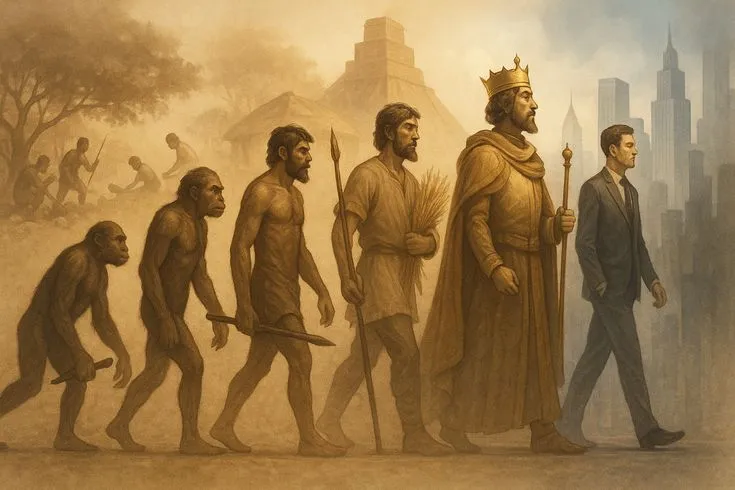
The idea of development or evolution is not exclusive to Darwin; rather, it already existed among the ancient Greek philosophers. For example, we find it among the Ionian natural philosophers, particularly in Anaximenes. We also find it elaborated in a pantheistic sense by Heraclitus and presented in a materialistic form by the atomists.
The great Aristotle incorporated it into his system but always attributed to it an organic and teleological nature. The idea of evolution already existed, but never separate from the idea of creation. Most believed that God had created the universe and the simplest forms of life and, from there, had guided a gradual and progressive evolution.
But in the 19th century, the concept of evolution was completely severed from its theistic foundations and placed at the service of materialism. It was Charles Darwin who delivered the final blow with his mechanism of natural selection. Darwin’s “merit” lies in having made an enormous number of field observations, through which he began to connect human life with that of animals, highlighting the kinship between them.
He then managed to combine them in a way never seen before, putting all his “discoveries” at the service of a hypothesis that was already widely dominant: evolution. From that moment on, many proclaimed that Darwin had killed God; that it was no longer necessary to believe in a creator. Supposedly, the explanation for how evolution had occurred had been found, and God was not part of that equation.
What does natural selection propose? Basically, it proposes that species evolved by adapting to the environment amid a cruel struggle for survival. In other words: individuals who, by chance, underwent some beneficial change would survive, while those not favored by chance would eventually disappear. In this way, the fittest survived and perpetuated their lineage. Over millions of years, this blind and random process led to higher levels on the evolutionary scale until we arrived at humankind. In simple terms, without scientific jargon, this is what Darwin’s theory of natural selection proposes.
The fact that natural selection exists is undeniable. But it only explains the relationship between species within the ecosystem where they live and their adaptation to it. Natural selection is completely incapable of explaining how species underwent macro-mutations and transformed into entirely new species.
First of all, no one has ever observed the emergence of a new species through natural selection. The only thing that has been observed is the adaptation of a species to a specific environmental change, but this has only produced an adapted species— —not a new species. The consistent experience worldwide is that a dog remains a dog, a pigeon remains a pigeon, and so on with all known species. No one has ever observed the emergence of a new species through macroevolution.
Since this is a reality that no one with even a shred of common sense can deny, evolutionists tell us that the changes are so small that they make evolution a very slow process and that, therefore, it cannot be observed in practice. And now we ask: Why do they call all this “science” if it cannot be observed and studied through the scientific method?
The problem is that, due to the popularity science has gained in recent centuries, everyone takes refuge in the terms “science” and “scientific” to lend credibility to their claims. But the science of evolutionism is mere showmanship—science in the service of spectacle. It is placed in the hands of the media to manipulate the masses. The great philosopher and philosopher of science Karl Popper (1902–1994) classified Darwinism as a metaphysical theory and found it laughable that it was called scientific.
The more science advances, the greater the problems it poses for evolution. However, if you take any text that purports to defend evolution and study it thoroughly, you’ll realize that it presents no compelling scientific evidence in its favor. These people take advantage of the masses’ ignorance to fill their books with confusing rhetoric, neatly cloaked in scientific terminology, yet conveying no knowledge with clear evolutionary implications that can be corroborated in practice. In short: they attempt to resolve the problems posed by science with mere rhetoric—superficial observations here and there, full of imaginary extrapolations—but no concrete scientific evidence to back up their claims. Let’s hear from the Christian philosopher Norman Geisler:
What they do is use “natural selection” as a magic word instead of providing an explanation. The mere fact of using a specific term and endowing it with powers of design does not mean that it can actually accomplish that task.1
Geisler continues:
Show me where natural selection has ever created a genuinely new type of organism, or even a new and functional organ. They have to give examples—and they don’t.2
True scientific knowledge is built on uniformity, not on improbability. The science of evolutionists is not built on what we can actually study and verify in practice: it is built on luck! Uniform experience shows us that complex information always originates from an intelligent being; the first life involved a , complex information; it is therefore entirely logical to assume that it came from an intelligent being.
To support evolution, they have to argue that even though things do not happen this way in the day-to-day practice of scientific observation, it could—by some mysterious chance—have happened this way in the origin and evolution of life. This is science built on chance, not on the reality that surrounds us.
Despite the above, we see how proudly they boast when they speak of evolution to the detriment of creation. And they consider themselves intelligent because their theory is based on “science,” while we Christians accept creation by faith in spite of the evidence. A clear example of this is the British biologist Richard Dawkins. He claims that Darwin has allowed him to become an intellectually satisfied atheist and is openly hostile toward those who believe in God, labeling them as stupid and brainless.
Believing in evolution requires not only faith, but also that this faith be blind and irrational. In contrast, Christians believe with a rational faith because everything they study in this wonderful and complex universe points to an intelligent Creator, not to nonsense and chance.
God bless you.
- Norman Geisler. Genesis, Creation, and Science, Vol. 1, No. 3
- Op